Showing posts with label Lucifer216. Show all posts

The fall of Wallovia

The tale I tell is one of woe, of blackest deeds and divine retribution. Long ago, the kingdom of Wallovia waxed mightily, its armies strong of arm, its forges burning night and day. Wallovia’s people were industrious, hardy, dour and serious folk. Jesters, clowns and travelling players learned to avoid the kingdom, given the Wallovians’ lack of interest in frivolity. Its ruling class kept to themselves and while outwardly they appeared noble and possessed of martial virtues in abundance, over generations of courtly intrigue family trees became dense and tangled, with cousin marrying cousin. This bred into the royal line a terrible temper that when provoked could rage like a burning fire and leave only ashes in its wake. 

Despite its wealth and power, Wallovia was at a crossroads for the new king, formerly Prince Valentine of the Western Marches, had spent much of his life abroad, travelling the realms and learning of the new ways, until his father’s untimely death forced him to return and assume the crown. His attempts to reform the kingdom sat ill with much of his subjects, for many and old were the traditions that they clung to. 

All too often, the young King would propose a grand new project only to be told by the priests and priestesses of Mortaine — the God of Death — that the ancestor-spirits advised against it. Always they gave sage council, for in truth Valentine knew little of his kingdom. He knew even less of the floods and storms that struck once every 10-score years or so and had made a ruin of many a promising architect. To the spirits of the long departed and by extension the priesthood, such events could be recalled at a whim. Over time Valentine grew obstinate and sour, made worse by his queen Katherina’s insinuation that the priesthood were the true rulers of the kingdom, not he. 

Matters came to a head when in one council meeting the priesthood had dismissed Valentine’s plans for new grain silos on grounds that his proposed site was too close to the marshes, so the grain would rot. The next item on the agenda, his decision to grant a trading delegation of the Khardron Overlords the right to build a sky port on land that had once been mined for tin again met with dismay bordering on derision. Surely, said Father Dou’gall – the oldest and wisest of the priests, the young king must see that such a heavy structure would quickly fall victim to sink holes and subsidence if built upon such ground? Finally, the priesthood dared to argue that Valentine’s proposed annexation of the nearby (and much weaker) kingdom of Ostvanland would quickly become bogged down due to the rains that frequently turned the roads between the two nations into seas of stinking mud. Father Dou’gall took great pains to explain that such had been the fate of an army led by Valentine’s great-great-grandfather over two hundred years ago and even summoned the shade of the young king’s ancestor to tell the tale. 

After the meeting had concluded, four of the king’s most loyal — and unscrupulous — knights overheard their liege lord mutter “who will rid me of these troublesome priests?”. Keen to serve his will, the knights rode out and put every last one of the priests to the sword and spilled Father Dou’gall’s brains across his own altar. 

Valentine appeared to be shocked to hear of his bondsmen’s deeds but was secretly pleased to be free of the priesthood’s prattling. As two of the knights were relatives of his queen he could not punish them to the fullest extent of the law, instead settling for posting them to guard the most remote corners of the kingdom. 

Despite a grim sense of foreboding among many, at first all was well and the people seemed blessed rather than cursed, their elders seemingly endowed with long life. It wasn’t until a series of bizarre instances began that the Wallovians understood what Mortaine had in store for them.

It began with a simple case of bad luck. Gregor, a young clumsy squire, was riding his horse in a practise joust when it fell and crushed his leg. Despite the best efforts of the healers, it became infected and while they immediately amputated the now useless limb gangrene had spread to his body. Despite untold agony, Gregor simply wouldn’t die. It wasn’t until he bit off his own tongue that his screaming stopped. Gregor was the first for whom the sweet mercy of death would prove elusive, but he was by no means the last.

At first there were a few cases, then before long everyone in the kingdom who simply wouldn’t die. Elders that would have died due to natural causes became crippled, unable to move and slowly going mad with thirst, hunger and pain unless someone was there to look after their every need. Some of the afflicted’s loved ones resorted to desperate measures, yet even after their screaming kin had been smothered and no longer breathed, still they screamed. Some piled their living dead with strong spirits and attempted to set them alight, reasoning that a brief period of bright agony would be better than years of the same, but each time they tried to start the pyres, a chill mist would appear from nowhere and smother the flames. Mortaine even spurred those that were beheaded, with their fellows forced to sew up the heads’ mouths to stop the endless screaming. 

To make matters worse, this curse coincided with Valentine’s long-delayed invasion of Ostvanland. While fatalities were inexplicably light in the opening battles and the Wallovians won many great victories, the number of incapacitated and walking wounded began to spiral out of control and the constant screams of those whose wounds had gone septic or had gut wounds that would drive them insane with agony started to make sleep impossible and shattered morale. Then the rains came and the choking mud plains that had once been roads made it almost impossible to keep the army provisioned. Men began to desert, first in ones and twos, then in a steady stream. 

Valentine found himself shaking his fist at the walls of Ostheim, Ostvanland’s capital, before he had to ride home with too few men left to commit to a siege. That night, a raid by Ostvanland skirmishers managed to sneak past Valentine’s exhausted guards and stabbed him to what they assumed was death. His last coherent words were to curse the knights that had brought this doom upon him and to beg Mortaine for a mercy that would never come. 

Back in Wallovia, things had gone from bad to worse, the harvest had failed and there were simply too many mouths to feed. In desperation, some sacrificed their last morsels of food on makeshift altars to Mortaine but their prayers for forgiveness fell on deaf ears, with a rare few — those known to have a smattering of witchery in their veins — swore blind that for a moment they heard hollow laughter in response to their pleads. 

Years passed and Wallovia fell into ruin. Mercy of a kind came in the form of the Ghouls of the Hollow Mountain as while men, women and children all had to endure the agony of being eaten alive, it meant that their bodily suffering was at last at an end. By that point, however, the entire kingdom had been driven irreconcilably insane. Once the ghouls had feasted, they returned to the Hollow Mountain, leaving a blighted and haunted ruin. 

It wasn’t until the Necroquake – that time when Nagash’s great design caused waves of death magic to spill across the mortal realms — that Mortaine’s vengeance was fully unveiled. From every tomb and corpse rose the spirits of the tormented dead. Filled with hatred of the living, they descended upon nearby settlements and towns, their rampage only checked when a full host of the Emerald Wardens’ Sacrosanct Chamber brought them to battle on the outskirts of Steepacre. Defeated by the might of Sigmar’s Stormcast Eternals, the Nighthaunt of Wallovia returned to their home and are to this day a malignant blight upon the Tallowlands. 


The Emperor's Lost Mines - Introduction

The Emperor's Lost Mines - Introduction

Many centuries ago, when the age of Chaos was ended by Sigmar's intervention, the races of the Tallowlands, many of them simple ordinary folk, rose and took arms against the forces of Chaos.  They joined with Sigmar's Stormcast Eternals to retake their lands in the name of order*


They needed to start equipping armies and anyone willing to fight..  In the southern realms of the Tallowlands, they found what they needed.  Rare ore from the hills and mountains and the purest coals and fuels for which to make a Forge - the forge of spells.  It was from here that the finest weapons and armour would be made, both magical and non-magical to equip the forces of Order as they pushed back against the forces of chaos at the start of the Age of Sigmar.  


One of Lucifer216's beautifully painted Stormcast Eternals

It was a time of unity, a time of peace — but it could not last.  Soon the Sinian Empire formed in the North and the races of men, dawi and aelves faded back into their fiefs and squabbles.  They had pushed chaos almost fully out of the Tallowlands and they wanted to enjoy the peace.

The Mine though, and the Forge of Spells, was not forgotten.  The area became first an outpost of the Sinian Empire and later a vassal Fief ruled from Krag-maw Castle, all the while supplying now a small but still significant number of magical weapons to the heroes and generals of the Sinian Empire.  Some of these would be locked in vaults but many of these were put to active use in defending the Sinian Empire from threats both internal and external.

Eventually, complacency set in.  The mine itself was overcome.  There are conflicting reports.  Some say it was a local Necromancer, yet other a beastman raiding party. Perhaps they both raided it.  The result was inescapable.  The mine was looted and its glory and even its very location were lost.  The Sinian Empire was too busy with internal problems to try and recover its remote outpost and its location was lost to time.


*Although behind closed doors this was a simple desire to be freed of slavery and tithe brought by the complacent and ancient forces of Chaos.

Dead hands never tire

I'm nearing the end of my lockdown-supported Ossiarch Bonereapers project. It's now only Katakros who stands between me and hobby completion.

Here's a look at some of the stuff I've painted recently, starting with the Ossiarch endless spells. While some might ungenerously say that endless spells are Games Workshop's way of getting another £22.50 out of everyone who wants to buy a new Battletome, I love the concept — as it adds so much character to each army, really emphasises the high fantasy tone of Age of Sigmar and provides an extra dollop of cinematic feel to the gaming table.

I painted mine using a very restricted colour palette — both for speed and to emphasise the fact that they are almost completely made of magic rather than magically sculpted bone.


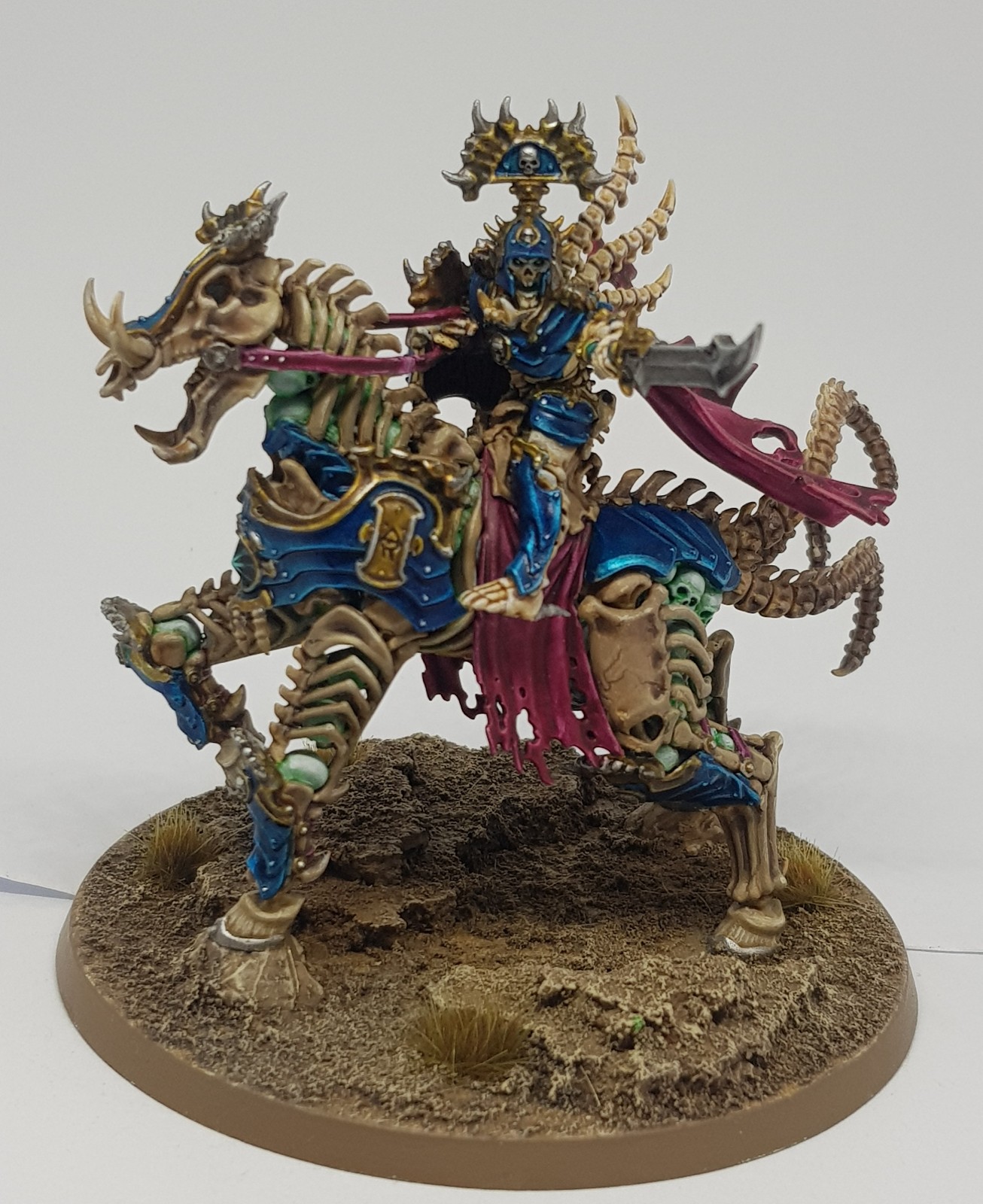
Up next we have a trio of Ossiarch characters, my Liege-Kavalos, a Mortisan Soulreaper and Vokmortian. I kept the Mortisan Soulreaper in my standard army scheme as I didn't really see the need to make him look more sinister and I was keen to see what he'd look like in a less dark scheme. My Liege-Kavalos fought me every step of the way — the model has a lot of detail crammed in around its centre and feels very cluttered compositionally. When I first saw the Vokmortian model, I was reminded of the opening scheme of 300 and while it's a nice enough model, it could have done with being on a larger scale to allow more space between the staff and his head.


Finally, here's my two Mortek Crawlers. I used a lot of contrast paints for the brown gradients/transitions and I was surprised at how just how much you have to dilute down the contrast paints to do so. My favourite bits are the glowing skulls — which I did using the method set out in the Battletome.


Painting the Emerald Wardens

I have something of a love/hate relationship with Instagram — on the one hand, I love the sheer amount of inspiration to be found and the amazing standard on display across the miniature painting community really motivates me to work on my own painting skills. On the other hand, I really don’t like the way that it currently tells you how many (or in my case how few) liked your work.

 Anyway, having really gotten into the Age of Sigmar lore and with my Ossiarch Bonereapers (the Nehekankh) almost completed, I had a hankering to do a Stormcast Eternals army and started looking on Instagram for inspiration for colour schemes, as most of the standard ones just weren’t grabbing me and I didn’t want to go down the (admittedly) awesome Hammers of Sigmar route. I stumbled upon baalu_wildheart’s incredible evocators painted in the colours of what I assure are the Celestial Vindicators and was instantly smitten!

I’ve not included any pictures of her models, but do check out the link, you won’t regret it. As I’ve long wanted to try my hand at the non-metallic metal (NMM) look, I thought it would be worth giving it a go. I realise that this is hardly an original approach, but given how much I have to learn as a painter, I think it’s really helpful having such beautiful models as a reference and a yard-stick for comparison.

 Rather amusingly, having experimented with a basecoat of Kabalite Green, sketching the highlights with Corax White and then using thinned Kabalite Green and another method (basecoating with a 4:1 mix of Kabalite Green and Corax White, followed by lots of glazes), I’ve discovered that baalu_wildheart very kindly posted details of her recipe for the turquoise and red some time ago.

 However, I don’t consider it time wasted as it’s been good practice. That said, I am glad that I started with the Stormsire's Cursebreakers from Nightvault rather than a part of my main army.

 Here’s my first attempt — she’s still WIP and now that I have a better idea of what I’m doing, I’m tempted to go back and fix a few things.


And here’s a (very WIP) second attempt. The use of glazing means I’m much happier with the transitions, but I reckon that the basecoat probably should have been a touch darker).


 I should add that while I love Baalu_wildheart’s colour scheme, I’m not a big fan of the Celestial Vindicators — they feel too much like pre-heresy World Eaters for my taste and while I do like the XIIth legion, I wanted to do something different lore-wise. Given that Apologist and others really wanted me to create my own Stormhost with some good links to the Tallowlands. It occurred to me that it would be great to have an band of stormcasts defending a damaged realmgate to Hysh that bathes everything in an emerald light and came up with the idea that they’re all drawn from partisans/guerilla warfare fighters — those who kept on fighting after their lands had been conquered by Chaos before Sigmar’s Tempest and the Age of Sigmar. You can find my background for my Emerald Wardens here.

A quick side-note on painting — one of the things I’ve learned fairly recently is the importance of continually looking at the model you’re working on from as many angles as possible. With the sheer amount of detail on modern miniatures, it’s very easy to miss areas and given that the eye relies on the borders between details to resolve them, it’s essential to be as neat as possible where one colour/material meets another (e.g. where the turquoise armour meets the gold trim). I’ve found that the Citadel Model Holder really helps in this regard.

To help provide consistency, here’s a list of all the paints I’m going to be using going forward. 

Baalu_wildheart’s turquoise armour recipe 
Vallejo Model colour Dark Sea Blue base colour Glazes of Game Colours Jade Green and Foul Green and Aquamarine (Pacific Color) for final highlights.

 Baalu_wildheart’s red fabric recipe 
Vallejo Model colour Burnt Red, Calvary Brown and Basic skin tone

 Red fabric (GW paint alternative) 
Basecoat Mephiston Red Shade with repeated applications of watered down Red Tone (in the shadows only) Highlight with Evil Sunz Scarlet, for the sharpest points on the folds use a 1:1 mix of this and Jokaero Orange, followed by pure Jokaero Orange.

Red gems 
As fabric but ignoring the shading step and starting with a basecoat of Gal Vorbak Red, highlight of Word Bearer Red, then Mephiston Red. Do final highlights of Jokaero Orange/white, then gloss varnish

Soul Crystals 
Basecoat Temple Guard Blue, Highlight with Lothern Blue, Highlight with 1:1 Lothern Blue/Corax White Final highlights on the corners of the crystal with Coax White. OSL the surrounding area with glazes of very thinned down Temple Guard Blue.

Off-white shoulder pads
Basecoat Morghast Bone Several layers of Wraithbone

NMM Gold
Basecoat Game Extra Opaque Heavy Brown (72.153), Wash with Sepia (72.091), Highlight with Game Extra Opaque Heavy Gold Brown (72.151) Highlight with a 1:1 mix of Heavy Gold Brown and Corax White Corax White for the most extreme highlights

 NMM steel 
Basecoat with Game Colour Cold Grey (72.050) Highlight and shade with mixes of Cold Grey and white or black as required. Note the NMM Vallejo guide/kit has a few more steps for adding some tone, but these aren't needed given that the areas are small and will get glazes for tone anyway on the swords. Note that the coloured swords require very light basecoats on which to work, so I’ve realised that it’s probably best to go Celstra Grey, Ulthuan Grey, Corax White (the latter used for the sharp highlights and little diagonal lines) and then apply contrast paints.

Blue/green/yellow transition on swords Talassar Blue and Warp Lightning contrast paints, with a thinned glaze of Lamenter Yellow towards the top. Basing Stonework/paving Rakarth Flesh Edge highlights and stippling with Pallid Wych Flesh Glaze of thinned down Dryad Bark (medium, and a little bit of water) Thinned down yellow glaze Mud Dryad bark, highlighted with roughly a 2:1 mix of Dryad Bark and Corax White. Leaves Basecoat Jokaero Orange Agrax Earthshade wash Red Tone wash

The Emerald Wardens

When Sigmar closed the Gates of Azyr, he consigned countless millions to the darkest of fates. Yet while the God-King turned his face from the mortal realms, many brave souls continued to fight on, even after their nations had been conquered by the barbaric hordes of Chaos. Hopelessly outmatched, theirs was a war fought with brains rather than brawn, in the shadows where sabotage and assassination were the tactics of choice. Those few who could not, would not, stand aside and let their conquerors obliterate all that had come before quickly learnt the value of misdirection, intelligence and subtlety. Those with magical talent soon became indispensable to the resistance, providing advanced warning of raids and determining who was telling the truth while those skilled in less subtle arts focused on destroying the fell monuments to the ruinous powers and places of worship that allowed daemons to enter the mortal realms.

Despite countless precautions, all of these partisans eventually came to grisly and unspeakable ends, either denounced by collaborators or hunted down by warbands created with the express purpose of weeding out dissent. To the surprise of their persecutors, as the executor’s axe fell often the condemned would vanish in a flash of lightning. Witnesses sympathetic to their plight would whisper that perhaps the gods of order had not forsaken them and the cycle of retaliation and reprisal would begin again.

Once the souls arrived in blessed Sigmaron and forged into Stormcast Eternals, they were amazed to find that Sigmar had not entirely forsaken them after all. However, this was of cold comfort to many for prior to their deaths they had been forced to make many terrible decisions — thanks in part to the bloody reprisals their occupiers would met out after every successful raid or assassination — and had been forced to watch their loved ones endure unspeakable hardship and the foulest of treatment at the hands of the ruinous powers. Even their initial forging had not expunged the pain of their memories and while they carried out their training with commendable diligence, there were some among the God-King’s council who feared that he had erred in creating such a troubled legion of warriors.

When the storm broke and the Emerald Wardens were at last unleashed, many of their number experienced no small measure of catharsis as they at long last were able to vent their fury upon their oppressors. However, on too many occasions, the Wardens would carry the day only for one of their number to collapse in mute horror as they witnessed all that remained of their former lands after centuries under the warping touch of Chaos.

 As the initial conflicts wore on, those who returned with their memories of their mortal lives burnt away by through their return to the Anvil of Apotheosis were looked upon by their fellows with a mixture of envy and pity, for there were no small number to whom their recollections of the past still defined them, no matter how painful they were to bear. For some, the memories of the past grew louder, not fainter with time. After more than one Emerald Warden deliberately died so that they may be reforged in the hope of losing their guilt to the Anvil of Apotheosis, large quantities of water from Lake Lethis in Shyish were procured at great expense so painful memories might be lost without the need for such drastic measures.

However, many of the Stormhost’s high command were concerned that in the rush to forget the horrors of the past, it might be deprived of valuable experience and information that might be invaluable when disseminated in secret to those mortals looking to throw off the brutal rule of Chaos, To this end, a small suborder was founded — the Unburdeners — with the task of recording all of the Emerald Wardens’ mortal memories, no matter how painful. When one of the Stormhost asks to drink of the waters of Lethis, tradition requires that they spend many hours telling an Unburdener every detail from their past, so that it may be recorded on vellum and stored in the Grey Chamber.

Some of the Emerald Wardens that have undergone repeated reforging seemed suffused with a fey emerald light while others would spontaneously recite seemingly nonsensical phrases that would later be recognised as true prophecies.

The grim demeanour of the Emerald Wardens is starting to lighten. When they were first posted to the Tallowlands, a significant minority of the Stormhost saw the deployment as one prompted either by Sigmar’s wish to keep them out of his sight least they prickle his conscience or in the foolhardy belief that time spent away from the horrors of full unbridled war would eventually salve their wounds. However, in establishing the Stormkeep of Zo and its supporting network of fortifications and waystations, the Emerald Wardens now lay claim to those who now fall in righteous battle within the Tallowlands — souls that have not languished under the yoke of the ruinous powers and are therefore free of the bitterness that lurks in the heart of some of its longest-serving members.

While this recent development has started to salve the wounds of the Stormhost’s past, it has only widened the isolation between it and its peers, as some of the more traditional Stormhosts fear that the number of souls who have spent their lives in service to the Everqueen entering the ranks of the Emerald Wardens makes its loyalty to Sigmar suspect. There are also some who look less than charitably upon the Wardens’ penchant for tricks, feigned retreats and misdirection, not to mention their tendency to speak in riddles and spout prophecy disguised as nonsensical gibberish.

However, none can question the remarkable battle record the Emerald Wardens have won nor the many battles in which they have fought in perfect synchronicity with their Sylvaneth allies.

After the fall of the Sinian Empire, the Emerald Wardens spent the best part of a decade warring against a tangled mess of barbarians, goblins, orcs and other more foul things, all seeking to take advantage of the sudden power vacuum and raid the Empire’s territory to their savage hearts’ content.

As would be expected, given their history, the Emerald Wardens maintain large Sacrosanct and Vanguard Chambers, with the latter comprising souls gathered from those who harried the hosts of chaos from the wild places of the mortal realms. Wardens of the Sacrosanct Chamber are frequent visitors to the Celestial College, where they can often be seen discussing the latest signs and portents with the College’s most accomplished wizards.

In the wake of the Necroquake, the Emerald Wardens have been given new orders. With the Penumbral Engines no longer working as Grungni intended,  Sigmar has recalled that two Grand Stormvaults are located within the Tallowlands — the Bloodied Briar and the Nightmare Hive. The former takes its name from the huge tangle of thorns that surrounds it, said to have been created by Alarielle herself at the God-King’s request and filled with dire artefacts plundered from Shyish in the hope that the life-magic coursing through Ghyran might counteract their potency. The Nightmare Hive on the other hand is filled with the most dangerous creatures, spells and magical constructions that the Everqueen and Sigmar discovered when they explored Ghyran together. Recently, the Emerald Wardens have heard rumours of a force of undead constructs moving slowly towards the Bloodied Briar. With no wish to repeat the Anvils of the Heldenhammer’s defeat at the Midnight Tomb, the Emerald Wardens are taking no chances and are preparing to crush this threat with overwhelming force.

Battlecraft
The Emerald Wardens rely heavily on illusion, misdirection and manoeuvrability. Their Lord-Celestants often seek to bewilder their opponents through their ability to call in reinforcements from Azyr and the speed of their Prosecutors. The Stormhost is also well known for its lateral thinking — At the great battle of Morlan-Zen, the Lords of the Fly watched in horror as what should have been an unstoppable wave of Beasts of Nurgle halted in its charge due to a battlefield that had been seeded with all manner of squeaky toys and shiny baubles the night before. Worse was to come when a squad of Vanguard-Hunters let off a great display of magical fireworks to the rear of the Rotbringer host, prompting the Beasts to excitedly crash through their allies’ ranks in an effort to get a better view of the aerial display.

Heraldry
While the colours of the Emerald Wardens closely resemble those of the Celestial Vindicators — a state of affairs some attribute to either an unimaginative and somewhat lazy scribe or a great surplus of viridium, the magical mineral used to tint sigmarite green —the finish of their armour is far more polished. While the similarity is something of a sore spot between the Celestial Vindicators and the Emerald Wardens, it has also proven to be an asset, given their contrasting approaches to war. Many battles have been won by the enemy expecting a full frontal assault only to die to a thousand cuts, or for the precautions required to guard against frequent raids making them easy prey for a spear-tip thrust to the heart of their host.

The archeologist's commission

Dearest Zarathustra, 

I trust this finds you well? I realise that it has been sometime since I had need of your unique skills and for this I can only apologise. Thanks to Slaanesh’s boundless generosity my circumstances have changed. We both have heard rumours of a great empire that had fallen to barbarians after reaching commendable heights in terms of raw sensation and most remarkably of all without the inspiration that the servants of the Youngest God can provide, due to its remote and mysterious location. Until now all efforts to discover the ruins of this place have been stymied. I say until now because a map has come into my possession, a copy of which I have enclosed. It appears that the civilization in question is the Sinian Empire, which is located in the region now known as the Tallowlands.

You can only imagine my excitement, for while as you know I possess arguably the greatest library of erotic literature in the eight realms and our blessed Cathedral of the Endless Consummation boasts five wings each devoted to a different collection of God-pleasing artefacts, in truth I fear we are becoming lax in our devotions. While my beloved Mineko continues to recite the classics with the perfect diction I and my congregation require, I fear repetition is causing her words to fall upon deaf ears. In short, we require novel sensation and I am looking to you, my dearest Zarathustra, to procure it for us. 

Seek out the ruins of lost Sinia, spare no expense and return to us all the works that have survived. Know that in doing so, you do the God’s work. But beware, if word has reached me, then it has surely reached less devote ears and I shudder to think of the few delicate wonders that remain being trampled on by the ignorant and unworthy. 

There is one more thing, you may have heard rumours of the God’s imminent return — I believe them with all my heart to be true. Each night I see glimpses of his divine countenance and I wake with my cushions stained with bloody tears. He will return and when he does it is vital that we celebrate my Darling Lord’s return with excesses the like of which the realms have never seen. For he will be thirsty for all that he has missed since his imprisonment. Of course, this necessitates complete knowledge of the revelries and debaucheries of the past and while we will of course fall short of this goal, we are far more likely to be able to offer up new and pleasing sensations to our lord if we know of those experienced in lost Sinia. 

Your loving patron,

Cardinal Xel’liath  

_________________________________________________________________________________

Dearest Cardinal,

It gave me great joy to hear from you and I delight in renewing our correspondence. Rest assured that I will make all haste to the Tallowlands and will not return until I am certain that no more can be recovered from the remains of lost Sinia. I am pleased to hear that Mineko is still providing you with good service — I will remember her reading of The Essence of Wrong until my dying day. I attach my list of expenses — I realise that they are already considerable, but it was difficult to find a Kharadron Sky-Captain willing to travel so far from established trade-routes and I had to take additional measures to ensure his absolute discretion in this matter. 

I can only hope that the Sinian Empire was not as fond of snakes as the defenders of the Temple of Sanguinary Splendour. As you know, I can’t abide such creatures and all those who mirror their forms. Similarly, it would be pleasing if the food of the Tallowlands is more agreeable to my constitution than that of Aqshy — you may recall the time I was forced to terminate a duel through the judicious use of my pistol due to a particularly potent meal of desert rat marinated in fire-chilli sauce. 

On a more positive note, my initial research indicates that I can expect minimal Sigmarite interference and I will provide a complimentary summary of my findings regarding the Tallowlands and their suitability for conversion along with the items that you require (assuming of course that they have not already perished to time’s embrace). 

Yours in rapturous debasement, 

Zarathustra d’Jons

The Golden Horde, the Nehekankh – the death which brings life


The Nehekankh — Lucifer216's Ossiarch Bonereapers

Nagash is the God of Death, the source of all necromancy and the scourge of those who would deny him his rightful soul-tithe. He’s also a terrible manager.

The hearts of his many servants do not beat, but the fear of the true death courses through their withered and decayed remains just as blood once did when they were among the living. Ask yourself, gentle reader, if such creatures would honestly tell someone who had engineered the downfall of entire civilizations that they might be able to fulfill his orders to the letter? The Mortarchs might dare to do so, but the nameless, the liches and necromancer-priests who scurry to obey? One might as well wait for the sand to rise up the hourglass. And so, the information that passes to the top of the pyramid is scant indeed; painstakingly polished until anything at all that might ignite the God of Death’s fury has been smoothed away. Furthermore, lies of omission and the actions required to prevent them from coming to light tend to multiply, gradually crushing all that which seems certain. It is this tendency that is the true genesis of the Nehekankh. Born from lies they are and of lies they must be. Their story begins when Nagash ordered the creation of the Ossiarch Bonereaper legions. At first all was well but as the task progressed his minions began to feel the first pangs of unease. Supplies of the necessary soul-stuff were quickly vanishing and yet the work on the last few legions had barely begun. It didn’t take long for his minions to realise that the Great Necromancer’s plans had not been adjusted to account for the souls that Sigmar had stolen from his grasp and used to create the Anvils of the Heldenhammer — the Stormhost forged from the aeons-dead heroes of the World-That-Was. It is not recorded by any scrimshaw-scribe who first proposed this course of action, but it wasn’t long before the soul-stuff required to make fearless, peerless killing machines was watered down with… other elements. Long had the Mortisan Soulmasons and their predecessors observed that mortals fighting for a cause seem to be far more effective than their lack of martial skill would suggest. The mother fighting to protect her young, the wounded man who bids his friends leave him so that they can escape, the son who takes up his father’s sword even its weight sits ill within his trembling hands. But this was not enough. And so it was that another source of soul-stuff was considered. In the darkest of oubliettes, known only to but a few, Nagash kept the souls of his former countrymen from the World-That-Was there to await his personal excruciation. But what need of such wretches for valour or skill at arms? All that was needed was their capacity for suffering. Normally, this would have been flayed away from them with the utmost care, but the risk of discovery was so great that much else was cut away in haste and decanted into the swirling mix of soul-stuff that was used to create the Golden Horde. At first all seemed well — Nagash’s latest legion was tasked with gathering the bone-tithe from Chamon, the Realm of Metal and the initial harvests of bone were plentiful. However, this was for two reasons — the Realmgate through which they had gained access to the Realm of Metal was far from the bulk of the conflict between the forces of Tzeentch and those of order and the sheer amount of bone waiting to be collected from Chamon’s battlefields and graveyards. As the Golden Horde continued its march and began full scale conflict with the realm’s native inhabitants along with daemons and Arcanites, such resources began to wane, forcing it to go on the defensive and dig deep into their scant reserves to build a network of fortifications.

An example of a Kavalos Deathrider in Nehekankh livery 

With the supply situation becoming critical, Liege-Kavalos Zalicazar and his retinue of Kavalos Deathriders sallied forth in search of a solution. The more they journeyed, the more they realised that the sheer amount of unbridled change magic and the depredations of daemons had cut a swathe through the human cities and settlements. Simply trying to raise cattle or grow crops was nearly impossible — a typical farmer would thank Sigmar if their cows and indeed themselves had the same number of limbs from sunrise to sunset. 

Returning weeks later with little to show for their efforts — and fearing the worst — Zalicazar and his companions were astonished to find that a dense and thriving jungle had sprung up almost overnight where the waves of unfettered and wild possibility collided with the deathly energies emanating from the Ossiarch Bonereapers’ fortifications. It was P’tah the most learned of the Golden Horde’s  Mortisan Boneshapers who first proposed the strategy of encouraging tribes and refugees fleeing lands made barren by wild magic to resettle in the newly fertile lands that ringed the borders of their territory. 

N’knef, the legion’s oldest and wisest Mortisan Soulmason pointed out in a voice like the crackling of dry leaves that this wouldn’t be enough — the legion would actually have to defend such settlements and tithe them sustainably, despite that doing so would directly contradict (at least in the short-term), their god’s vision of a perfect unending lifeless necrotopia. But the vague and far off possibility of being unmade as heretics by their ultimate master paled into insignificance when weighed against the absolute certainty of disgrace and torment should they return to Nagashizzar in failure. 

So it came to pass that a legion of animated bone revenants raised with the sole purpose of ushering all life into the malign grip of Nagash has become the Nehekankh – the death which brings life. 

As the decades has passed, the legion has become more comfortable with its decision — for nurturing the human settlements and even inducting the souls of the departed into their ranks with only the slightest refinement sits more naturally with them then the many massacres they carried out when the legion was first unleashed and the legion’s masters have long struggled to understand what would be required of them should Nagash’s vision ever come to pass. 

However, this inner peace is an uneasy one for all of the legion who carry the spark of sentience fear the day that Nagash eventually learns of their blasphemy. To forestall that dreaded day, great cartloads of bone are dispatched back to Nagashizzar with ever-increasing frequency — for the settlements have become great cities thanks to the unceasing labour of deathless hands and the supernaturally fertile fields that surround them. 

But the cities are no longer the Nehekankh’s only source of bone — for its strength has grown and its reach is long. Its leaders are no longer content to garrison walls and defend their livestock. They take the battle to the chaos filth who pollute their lands, while to the south the jungles have become infested with Seraphon — and their great beasts’ remains make the perfect raw material with which to build more Gothizzar Harvesters.

Meanwhile, to further increase their chances of survival once the Great Necromancer eventually discovers their betrayal, the Nehekankh have sent out expeditionary forces across the realms in search of unpillaged stormvaults and the wonders within. This search has led a small force to the Tallowlands...