Of Kazad Nogthrong, City-state of the Gorm Range Dawi
 |
| Eorlcyng Nialon the Disapproving, and Snorri Spilaf, Thegn of Nog |
Deep in the Gorm Ranges – known to the dwarfs as Migdahlgorm – sits the great city-state of Kazad Nogthrong. This is the ancestral seat of the Dawi Cyng Nog, to whom most of the western dwarfs of Rhô pay allegiance.
The greatest, though not the highest, peak is threaded through with the Seat of First; a mighty fortress occupied by the first dwarfish settlers of the region long ago in the Age of Myth. The tale of the construction of the first keep – now the core of a sprawling fortified complex – is written, on an entire panel of the great Avenue of Stone that runs to the throneroom.
Thereon is carved the Fourth Feat of Nog, a tale in which the Cyng-before-all managed to bribe the gods themselves to assist in constructing his fortress. Over the course of three moons, he used his great cunning and craftsmanship to sow seeds of jealousy amongst the gods; gifting first one, then the next with ever more wondrous dawi-made armaments, ornaments and trinkets.
Through the demonstration of each, Nog tricked the gods into carving and shaping the mountain into a sky-scraping hold fit for the deities themselves – and then, once it was complete, used the last gift to shrink it to a size fit only for the dawi-folk. The rage and anger of the gods were unleashed upon the fortress, and the deities battered themselves against the impregnable fortress they themselves had created. At last, anger turned to exhaustion, then amusement, and at last respect for the cunning of Nog.
It is written that this is not myth, but history; and the dawi have sought the treasures of Nog ever since the elves displaced the gods.
Thereon is carved the Fourth Feat of Nog, a tale in which the Cyng-before-all managed to bribe the gods themselves to assist in constructing his fortress. Over the course of three moons, he used his great cunning and craftsmanship to sow seeds of jealousy amongst the gods; gifting first one, then the next with ever more wondrous dawi-made armaments, ornaments and trinkets.
Through the demonstration of each, Nog tricked the gods into carving and shaping the mountain into a sky-scraping hold fit for the deities themselves – and then, once it was complete, used the last gift to shrink it to a size fit only for the dawi-folk. The rage and anger of the gods were unleashed upon the fortress, and the deities battered themselves against the impregnable fortress they themselves had created. At last, anger turned to exhaustion, then amusement, and at last respect for the cunning of Nog.
It is written that this is not myth, but history; and the dawi have sought the treasures of Nog ever since the elves displaced the gods.
***
The Seat of First broods at the northern tip of the Great Scar, a massive canyon torn through the mountain range by some long-forgotten firce. The fortress stands tall, but its roots descend many fathoms, running down the whole depth of the Scar itself, and back into the mountains. The fortress is thus far taller than it is broad, and is home to many thousands of dawi-folk who make a living from mining the ore and precious minerals revealed by the scar.
 |
| Nogthrong is built along a great scar that runs through the Gorm Ranges. |
Along the rest of the scar are dotted watchposts, thrall-villages and mountain towns, where dwarven merchants, craftsmen and farmers make their living. The outermost are open to other folk who come to trade or seek an audience with the Cyng. Over the centuries different Cyngs have stamped their identity on the region; some fond of visiting elven bards and human merchants, others jealously inward-looking who closed the whole kingdom to non-dawi. It remains to be seen how the recently crowned Cyng will treat his people, and those beyond. Those who have met him speak of a flint-eyed and hard-voiced dwarf, a Cyng like those of old.
***
Allies of Nogthrong
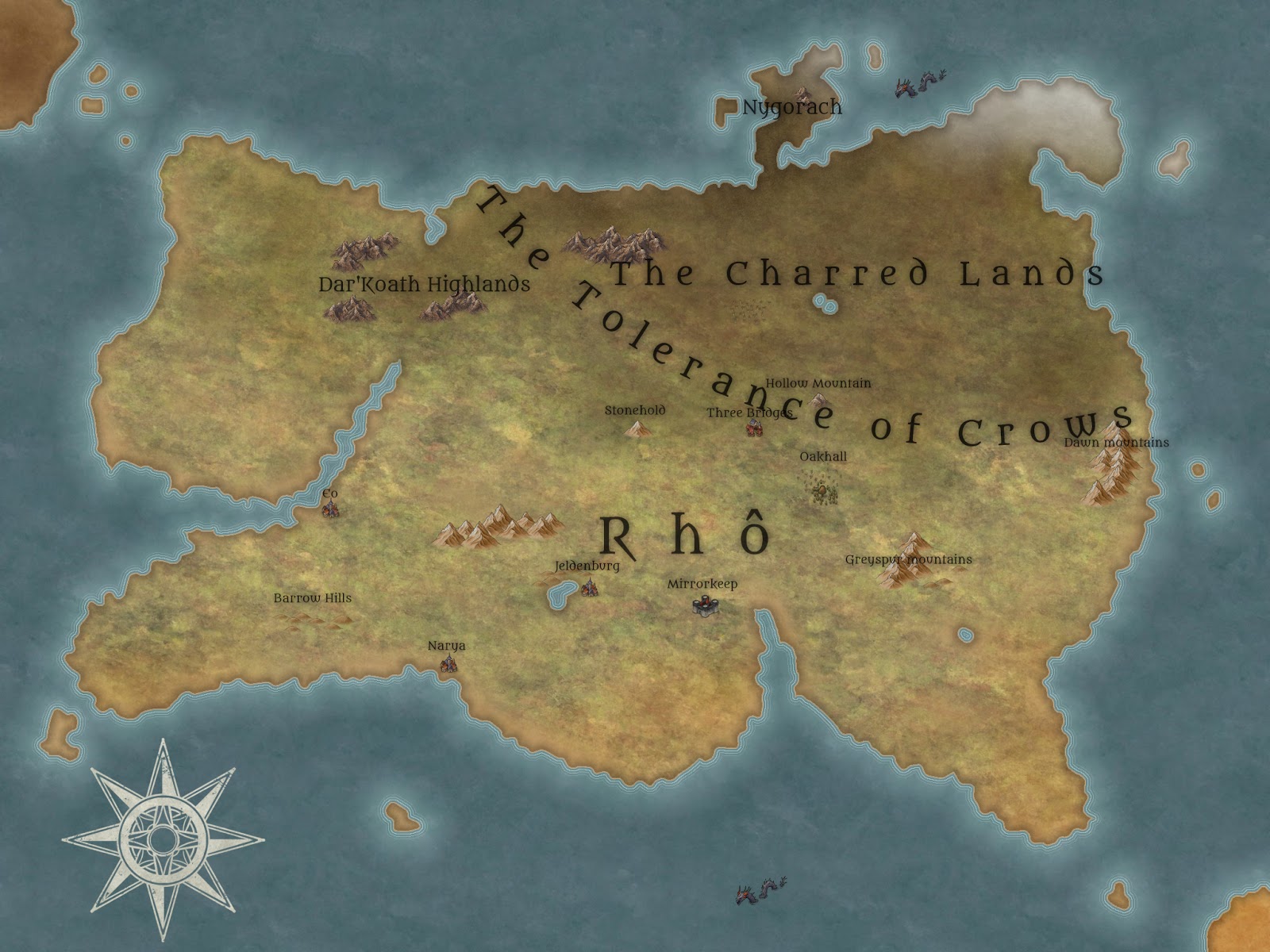
To the north of the Grom Ranges lie the Middle Kingdoms. This region was historically home to dwarfs, men, elves and other civilised peoples, though today the remaining towns and villages are fortified against the roaming hordes of greenskins, nomadic beastmen and similar villains.
Travelling further north will reveal the imposing silhouette of the Dar'Koath Highlands, a still harder and more bitter mountain range than the imposing Gorm Ranges. In this bleak region are warring barbaric tribes of orcs, humans, and stranger things besides. On the Easternmost peak stands Durak Undi, an outpost and remnant of a once-great dawi kingdom, long since fallen to ruin. None today remember the fall of the kingdom, but it was said by the wise and learned to have been a lesson sorely forgotten – for the fall of the dwarfs here proved to be a foretelling of the fate of the Sinian Empire.
 |
| Annotated map of the Dwarfs of Migdahlgorm and the surroundings |
Eorlcyng Nialon, living in exile in Kazad Nogthrong, believes his line to be the last scions of the lost dawi kingdom. He has petitioned the new Cyng to lead an expedition to Durak Undi, there to discover whether dwarf-folk remain, and to resettle the lands of his ancestors. The distance is great, and a host of rare power must be drawn up to ensure such an expedition's success; so it remains to be seen whether the new Cyng of Nog will grant his request...

***
The peace and quiet of painting usually allows my mind to wander a bit, and I tend to find it a good time for developing a bit of back story for the figures I'm working on. I wanted to make sure that the Nogthrong (my army) had a place in the Tallowlands, but not to make it so isolated that there's not really any reason to fight battles. After all, Warhammer Fantasy Trade Negotiation doesn't have quite the same ring, nor need of chainmail-clad warriors.
With that in mind, I decided that Kazad Nogthrong would be my dwarf's 'main base'; a combination of surface stronghold, underground city and a surrounding area of farms, orchards and similar above-ground necessities. Located in the range of mountains between the cities of Jeldenburg and Eo, this is a fairly central location.
Dwarfs from the World That Was (the Old World of older editions of Warhammer) have a very fixed background. While that was wonderfully rich, I want to have some freedom to develop away from it. so the Nogthrong will – hopefully – have a mix of familiar and innovative concepts.
One of these is the concept of thrall settlements. Not all dwarfs in the Tallowlands live huddled in keeps or underground. Dwarf country includes thriving villages, towns and even cities that take care of things like growing barley for bread and beer, managing livestock and so forth. While some of these are wealthy enough to afford mercenaries to defend themselves, most owe allegiance to an eorlcyng – a sort of local independent chieftain that oversees an area of a few villages and a town or two. In turn, these eorlcyngs owe allegiance through a complex and ancient series of oaths to the Cyngs, the most powerful of all the dwarfs of the region.
 |
| Snorri Spilaf (right), is an example of a Thegn – an important rank in the court of Nog. He bears the Throng's banner. |
In times of war, famine or plague, thrall settlements will look to the wealth and military strength of the eorlcyng; who in turn can turn to the Cyng himself to summon further aid. In return, the settlements pay a tithe to the eorlcyng, part of which is paid to the Cyng. Thus the dwarfs have a feudal system of mutual support.
Nialon (pictured above) is an example of one such Eorlcyng, who will be used as a Warden King in-game. This was one way I found to square the circle of having multiple Kings in an army – some are nominally independent (as suits a proud dwarf), but with a measure of subservience. Nialon doesn't have to support Cyng Nog, but he'll generally find he – or his descendants – benefit if he joins in.
***
So far, the Tallowlands only has one Cyng – that of Nogthrong, but I wanted to leave the concept open in case other Cyngs need to be created, or one of the PCRC decide they want to paint up some dwarfs. Might make for some nice mercenaries, for example – or even a whole new army.
***